
Kissimmee Youth Academy Discharge Paths
Kissimmee Youth Academy is part of Florida's juvenile system. A youth's departure must be understood through the juvenile order and the agency responsible for the placement. The research supports several possible outcomes at a high level: an authorized discharge, a transfer, or another court-directed placement. A physical move does not always mean that all juvenile supervision or court authority has ended. The receiving person or program, if one exists, is therefore as important as the departure date.
The term "released inmate" can mislead here. Academy residents are not part of the Osceola adult jail population, and DJJ records should not be recast as adult booking or prison records. An authorized parent, guardian, attorney, or other person should ask whether the event was a final discharge, a transfer between juvenile programs, or release to an approved custodian. That precise label prevents a move within the system from being mistaken for a full end to the placement.
| Possible event | What it establishes | Best confirmation path |
|---|---|---|
| Authorized discharge | The academy placement ended under juvenile authority | DJJ, the juvenile court, counsel, or the facility |
| Release to a custodian | The youth left the facility with an approved person | The authorized custodian and responsible juvenile office |
| Transfer or new placement | Custody or program responsibility continued elsewhere | The sending and receiving juvenile authorities |
Confirm a Kissimmee Academy Discharge
There is no adult public-roster shortcut for a Kissimmee Youth Academy discharge. The proper path starts with the requester's relationship to the youth and the office responsible for the juvenile case. A person without authorization should not seek restricted identity or placement details. A person with a valid role can use the following sequence to keep the request narrow and direct.
- Confirm the exact facility name. Kissimmee Youth Academy is distinct from the adult Osceola County Correctional Facility and from Kissimmee Community Release Center.
- Contact the academy or the responsible DJJ channel and state the requester's relationship to the youth. Be ready to follow the identity and authorization process the agency requires.
- Ask whether the relevant event was a discharge, transfer, or court-directed placement. Do not assume that leaving the building ended every juvenile obligation.
- Use counsel or the juvenile court when the answer depends on an order, disposition, or case restriction. Those channels can explain the legal action without treating the adult roster as evidence.
- Confirm any receiving custodian or program only through an authorized source. Avoid sharing the youth's information beyond those who have a lawful role.
The broader Osceola County release search explains how adult county, state, federal, and immigration records differ. Its adult lookup steps do not replace the restricted juvenile path described here.
Kissimmee Youth Academy Contact
The facility is the most direct local starting point for an authorized discharge or transfer question. Call before visiting and explain the relationship to the youth. The researched source set does not provide public records-office hours, so no hours should be assumed.
Kissimmee Youth Academy2330 New Beginnings Road
Kissimmee, FL
407-350-4900
Florida Department of Juvenile Justice residential facility
A facility contact may direct an authorized caller to DJJ, the juvenile court, assigned counsel, or another responsible office. That referral is part of the correct process. It is safer than sending a juvenile question to Osceola Corrections Records, which maintains the adult county jail channel.
Kissimmee Youth Academy Residential Role
The official DJJ facility page identifies Kissimmee Youth Academy as a high- and maximum-risk residential facility. Its population is male youth ages 14 through 21. DJJ reports a capacity of 95. These facts define the academy as a juvenile residential program and explain why an adult jail locator is the wrong tool.
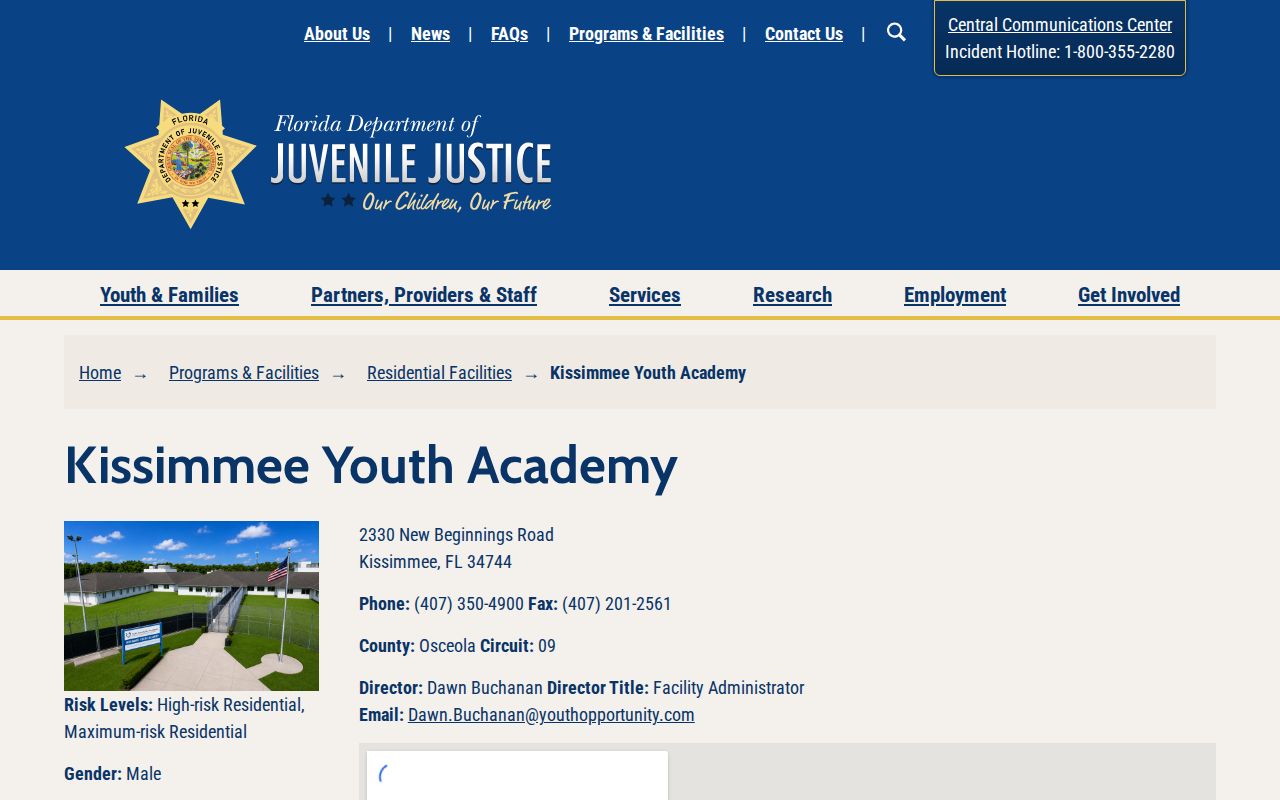
The official page anchors the facility identity and program type. It does not turn protected resident details into a public released-person list, and it should not be read as one.
Kissimmee Academy Is Not Adult Custody
Three local names can create confusion. Kissimmee Youth Academy is a DJJ residential facility. Osceola County Correctional Facility is the adult county jail. Kissimmee Community Release Center is an adult FDC community-release site. The fact that all three appear in the Osceola service map does not place them in one database or under one release process.
Searching the county adult roster will not establish whether a youth remains at the academy or has been discharged. The FDC adult offender search is also not the right route for the academy's juvenile population. Likewise, the county's adult daily arrest report and adult release-record request process should not be used as substitutes for DJJ and juvenile-court channels. The sibling page for Orange Regional Juvenile Detention Center explains a secure detention role, which differs from this academy's residential role.
- Residential facility
- A juvenile program placement under DJJ authority.
- Discharge
- The documented end of a particular placement or juvenile responsibility, as defined by the responsible authority.
- Transfer
- A move to another custodian or program, which is not the same as unrestricted release.
Kissimmee Discharge Court Roles
A juvenile court order can control placement, movement, or discharge. That makes the court and counsel important when a family needs to understand what the facility action means. The academy can confirm what its authorized staff may disclose, but it cannot change the meaning of a court order. Conversely, a court entry may describe the legal direction without supplying the practical handoff details known to the facility or approved custodian.
Use both sides when necessary. Ask counsel or the juvenile court about the controlling order. Ask the academy or DJJ about the program event and the correct next contact. If the youth was released to an authorized parent or guardian, that person can confirm receipt within the limits of the case. This divided approach avoids demanding a single public document that the juvenile system does not offer as an adult-style release sheet.
The distinction also keeps dates in context. A date supplied by a court may identify an order or hearing, while a facility record may identify the actual program movement. Those dates can be related without being identical. An authorized requester should ask which event each date represents and avoid calling a planned or ordered date a completed discharge until the responsible juvenile office confirms the movement.
Kissimmee Academy and ICE Transfers
Osceola's adult county system has a separate 287(g) Warrant Service Officer relationship. In that adult setting, a county record marked "released to other agency" can mean county custody ended while ICE custody began. ICE's locator may include a person now detained or recently released from ICE custody. That documented adult transfer issue does not make Kissimmee Youth Academy an ICE facility.
No dedicated ICE detention center was verified in Osceola County, and the academy is identified by DJJ as a juvenile residential program. Questions about a youth's academy discharge still begin with authorized DJJ, court, counsel, parent-guardian, or facility channels. An adult ICE locator should not be used to probe for juvenile academy details. If an authorized legal representative identifies a separate immigration matter, that representative should follow the agency and court channels specific to that matter without merging it into the academy's ordinary discharge process.