
Osceola Facility Release Paths
The Osceola County Correctional Facility is the county’s central adult jail. A person can leave its custody through bond, cash bail, pretrial release, sentence or time served, another court-authorized event, or transfer to another agency. Those events do not have one legal meaning. Bond and pretrial release can occur while a case remains pending. Time served can reflect completion or credited time. A transfer closes county custody but does not establish a return to the community.
The county’s daily statistics use local categories such as pretrial release, released to bondsman, cash bail, other agency, and time served. The report provides dated aggregate counts, not names. It can help interpret county terms but cannot confirm one person. Ask for the actual release type tied to the booking and request the code legend if the record uses an undefined abbreviation.
| Release path | What it establishes | Next check |
|---|---|---|
| Bond or cash bail | County secure custody ended while the case may remain open. | Release sheet and Clerk docket |
| Pretrial release | The person left secure detention under local supervision conditions. | PTR record and court case |
| Time served | The jail applied a sentence or credited-time outcome. | Sentence order and release sheet |
| Other agency | Osceola custody ended through transfer. | Receiving agency locator |
| FDC commitment | The person entered the state correctional path. | FDC search by DC number |
Confirm Osceola Facility Release
The official Osceola inmate population answers whether Corrections listed the person at its latest update. A match supports current Osceola custody at that time, though the search count can include people housed elsewhere. A missing match does not by itself prove freedom. Release, transfer, a different agency, an identity mismatch, or a corrected record can all explain absence.
- Search the exact name and preserve the county inmate ID, booking number, and case reference from a valid match.
- If the person is absent, check the date-selectable arrest report for the booking lead, not for release proof.
- Use the case reference in the Osceola Clerk docket to review bond, disposition, sentence, and later orders.
- Check Florida VINE for a custody event and match the reporting agency and identifiers.
- Request the Corrections booking and release sheet with date, time, release type, and receiving agency.
- Follow FDC, ICE, BOP, or another county when the sheet records a transfer.
A released profile disappears during the next several-times-daily update. That is how the county designed the current roster. The broader county search and records sequence is available through the Osceola County released inmate search.
Osceola Facility Release Records
A complete request should tie one person to one booking. Include full legal name and aliases, date of birth, county inmate ID, booking number, approximate booking date, and case reference. Ask for booking date and time, completed release date and time, release type or disposition, charges and case numbers attached to the booking, destination or receiving agency, and the booking photograph if needed.
The Osceola Jail Record Requests page links the county public-information portal. Routine requests are handled during normal business hours, and the county gives notice of charges after review. It does not promise a fixed turnaround. A narrow date range and named fields can reduce retrieval and redaction work.
402 Simpson Road
Kissimmee, FL 34744
Main: 407-742-4444
Records: 407-742-4411
Bonds and Dockets: 407-742-4404
For documentary proof, request the written or certified record instead of relying only on a phone answer. The Clerk is the source for the case order, not the jail’s exact door-out timestamp.
Osceola Correctional Facility Identity
The operator is the Osceola County Corrections Department under the Board of County Commissioners. It is not a Sheriff-run jail. That distinction controls records routing and official wording. Corrections maintains the jail record. The Sheriff’s Office remains the county contact for general warrant confirmation, while Corrections says its staff cannot perform general warrant checks.
The official department source documents the jail’s identity, operation, history, and current facility facts. Review the Osceola Corrections Department page with the captured record.
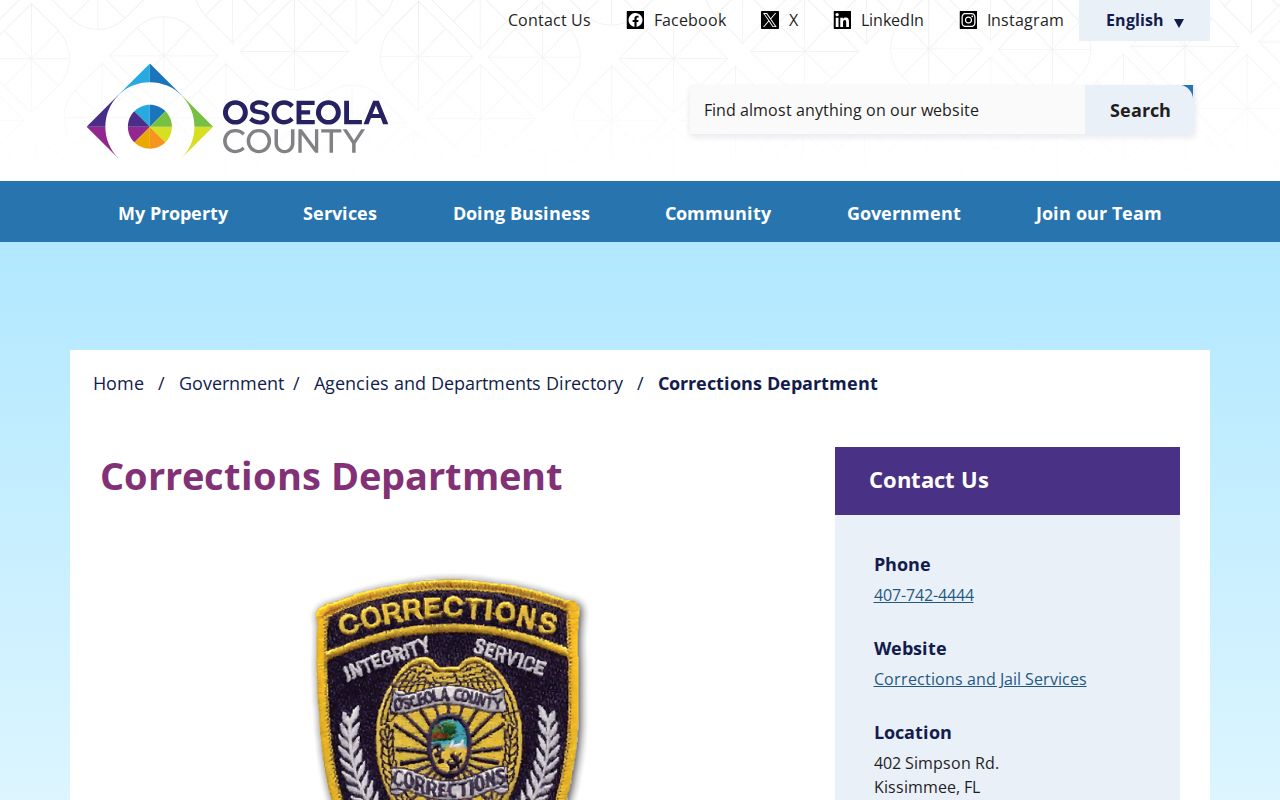
The source confirms that county government, not the Sheriff, operates the facility. It also provides the basis for its dated capacity and population facts.
Osceola Facility History and Design
The jail was constructed in 1986. Renovation in 1998 and 1999 refurbished administrative, intake, and medical areas. The project also added two direct-supervision areas, multipurpose spaces, and a kitchen. These details describe the facility, not annual release volume.
Responsibility changed on March 1, 1997. The Sheriff had operated Corrections before the Board of County Commissioners assumed control. Modern release searches and records requests therefore belong to the county Corrections system. Generic instructions that refer to a “Sheriff roster” or Sheriff jail app would be wrong for Osceola.
The county reports consecutive accreditation history and a 2025 average daily population of 846 against a design capacity of 911. Those figures are tied to their stated dates. They must not be converted into a release count or a claim about current occupancy.
Note: Facility capacity and average daily population describe jail operations; neither figure identifies who was released on a given day.
Property After Osceola Facility Release
Osceola’s inmate-services material documents a practical post-release path. A former resident can sign into SmartJailMail with the inmate number and password to download processed photos, messages, and postal mail without charge. The former resident cannot respond or open institutional request, grievance, or medical forms through that access.
Read the official inmate mail and property page beside the captured instructions.
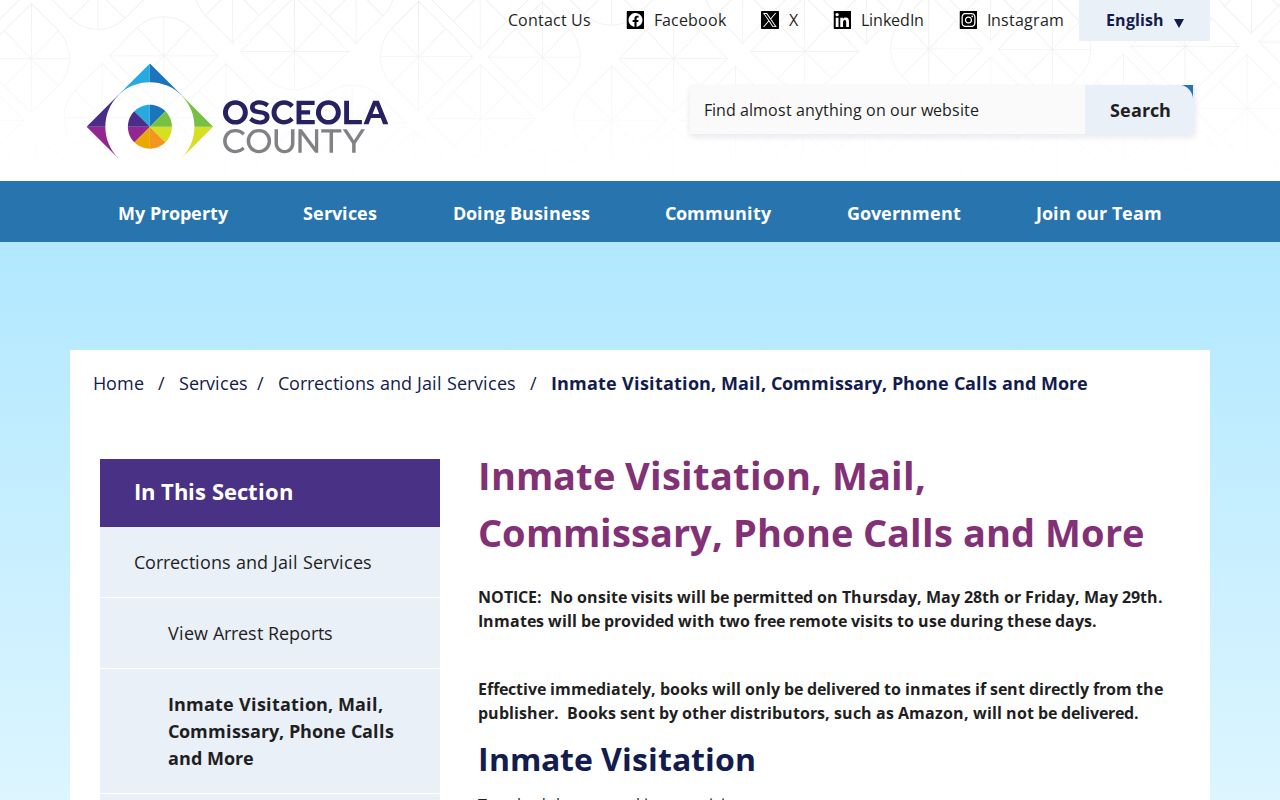
The county guidance shows that digital access can continue after release in a limited form. It is an administrative service, not proof of case disposition or the release time.
While a person remains in custody, giving property to someone else requires written authorization that identifies the items and recipient. The jail then contacts that person to set an appointment. Incarceration records may also contain receipts for property or money returned at release and transfer documents showing what moved with the person.
ICE Transfer After Osceola Release
Osceola’s 287(g) Warrant Service Officer relationship makes the “released to other agency” field important. County criminal custody can end while immigration custody begins. The relationship supports a detainer or transfer role. It does not make the Osceola jail a dedicated ICE detention center, and no such ICE facility was verified in the county.
Ask Corrections to name the destination and receiving agency. Then use the ICE Online Detainee Locator. The strongest search uses the A-number and country of birth; the alternative uses name, date of birth, and country of birth. ICE says its locator includes people currently detained or released from ICE custody within the prior 60 days. No match is not conclusive because records can lag or be withheld from public display.
A federal transfer can also bypass a useful BOP result at first. The U.S. Marshals Service handles many federal pretrial detainees, while BOP records are most useful for sentenced federal custody. Follow the agency named on the release record.
After Osceola Facility Release
The release record and court docket answer different questions. Corrections establishes when and how its custody ended. The Clerk docket can show why a judge authorized bond, pretrial release, sentence credit, or another order. Florida VINE can add notice of a custody event. None should be forced to answer a question held by another system.
For an FDC commitment, switch to the state offender search and use the DC number. For immigration custody, use ICE. For federal custody, use the federal docket, USMS contact, and later BOP locator when applicable. Another county transfer requires that county’s custodian. Stable identifiers prevent records from being merged on name alone.
A person outside secure jail can remain subject to pretrial conditions, county probation, state supervision, or another court order. Release from the Osceola County Correctional Facility is one completed agency event, not a universal statement that every form of legal control ended.
Identity must stay tied to the same booking. Compare full legal name, aliases, date of birth, county inmate ID, booking number, physical descriptors, case number, and custody dates. A county booking number is not an FDC DC number, federal register number, or immigration A-number. When two records share a name, the agency identifiers and event dates decide whether they describe the same person. The strongest release evidence comes from the office whose custody ended, while the receiving agency supplies the next status.