
Orange Regional Juvenile Release Paths
Orange Regional Juvenile Detention Center holds youth pending adjudication, disposition, or placement. Those three stages matter when interpreting a departure. Adjudication concerns the court's determination in the juvenile case. Disposition is the court's ordered outcome. Placement identifies where the youth may be sent under juvenile authority. A release from secure detention can therefore mean handoff to an authorized custodian, transfer to a residential program, or another court-directed move.
The word "release" should describe the detention center's event without overstating it. If the youth leaves secure detention for a residential facility, juvenile responsibility continues in another setting. If the youth goes to an approved parent or guardian, court requirements may still remain. Only the court, DJJ, counsel, facility, or authorized custodian can establish the precise result for that youth. Public adult search tools do not supply this answer.
| Departure path | What may continue | Who can confirm |
|---|---|---|
| Approved custodian | The juvenile case or court conditions | DJJ, court, counsel, facility, or authorized custodian |
| Residential placement | DJJ placement authority in a different program | Sending and receiving juvenile authorities |
| Court-directed transfer | Custody or placement under the order | The juvenile court, counsel, and responsible agency |
Confirm an Orange Regional Release
An authorized person should begin with the exact facility and the county tied to the juvenile matter. Orange Regional serves more than one county, so saying only "regional detention" may not be enough. The requester should identify the relationship to the youth and follow the agency's identity and permission requirements. The goal is a narrow confirmation, not access to a public list.
- Confirm that Orange Regional Juvenile Detention Center is the relevant facility. Do not confuse it with an adult jail or a DJJ residential academy.
- Call the facility and identify the Osceola County connection, if applicable. State whether the caller is a parent, guardian, attorney, or another authorized participant.
- Ask whether the event was release to an approved custodian, transfer to a placement, or movement under a court order.
- Contact counsel or the juvenile court when the question concerns adjudication, disposition, or the legal effect of an order.
- Confirm the receiving person or program through the responsible juvenile authority. A departure time alone does not show that all authority ended.
The Osceola County released-person search separates adult county, state, federal, and immigration routes. Those adult channels provide context, but they do not replace authorized juvenile confirmation.
Orange Regional Release Contact
The facility is located in Orlando even though it serves Osceola County youth as part of its regional role. An authorized caller should use the official number and clearly identify the facility, the relevant county, and the caller's relationship to the youth. No public contact hours were documented in the research, so call ahead before planning any visit.
Orange Regional Juvenile Detention Center2800 South Bumby Avenue
Orlando, FL
407-897-2800
Florida Department of Juvenile Justice secure detention center
The facility may route a permitted question to DJJ, the juvenile court, counsel, or the responsible county channel. That routing is appropriate for a regional center. Osceola County Corrections Records holds adult jail material and should not be asked to disclose a juvenile detention record from Orange Regional.
Orange Regional Juvenile Custody
The official DJJ detention-center page identifies Orange Regional as a secure detention center serving Orange, Osceola, and Seminole Counties. DJJ reports a capacity of 95. Its regional and secure-detention roles distinguish it from both the Osceola adult jail and a longer-term juvenile residential placement.
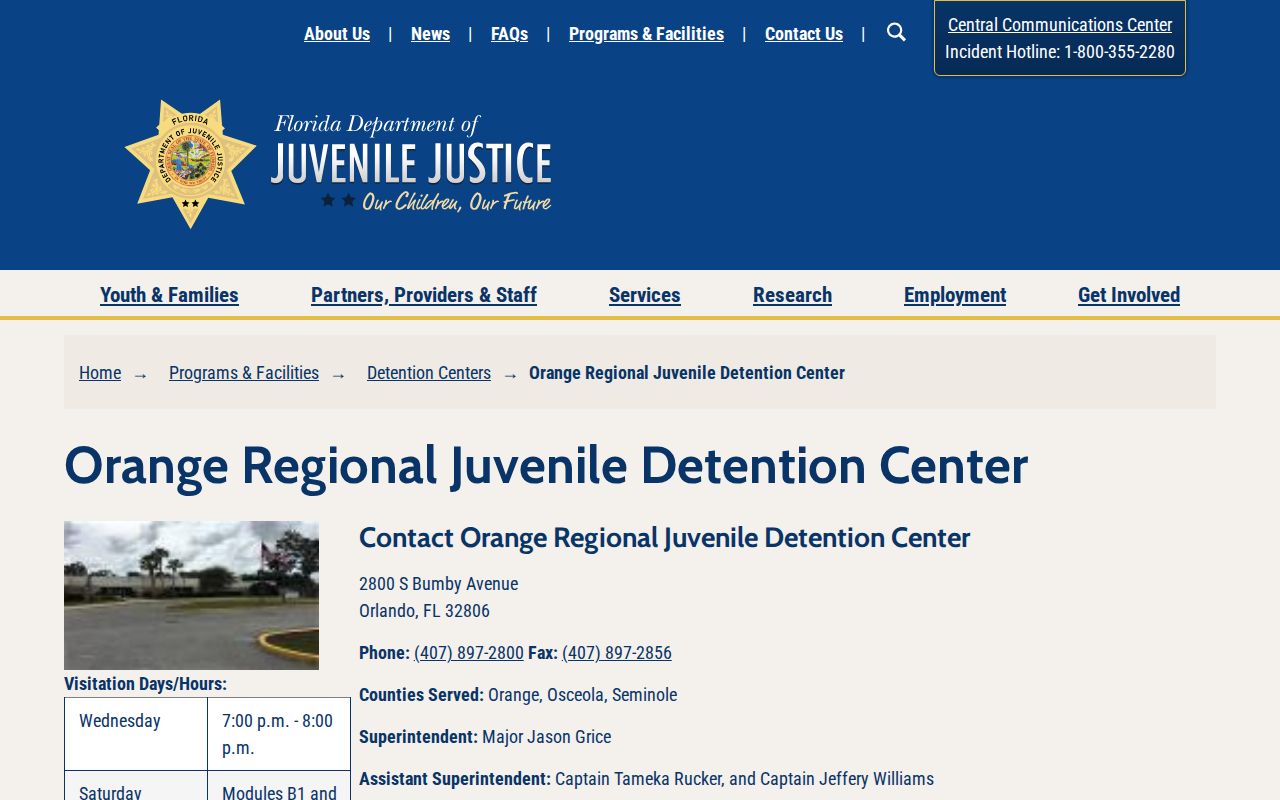
The official page confirms which counties the facility serves and the nature of the site. It does not provide a public roster of youth or an adult-style recent-release archive.
Osceola Youth at Orange Regional
Orange Regional's Orlando address can cause a family to search the wrong county system. The center serves Orange, Osceola, and Seminole, so the building's location does not by itself identify which county's juvenile matter controls. An Osceola connection should be stated when an authorized person contacts the facility, court, DJJ, or counsel. That detail helps the receiving office route the inquiry without disclosing more than the requester is allowed to receive.
Regional service also means that names alone are unsafe identifiers. A requester should use case or agency details already lawfully known to that person and should avoid combining records based on a shared name. The facility can explain what verification it needs. Counsel can connect the youth to the correct juvenile matter. A parent or guardian can identify the family relationship, but the agency still decides what may be disclosed.
Orange Regional Release Versus Placement
Secure detention and residential placement are not the same facility role. Orange Regional holds youth while a case stage or placement is pending. A residential facility serves a program placement under DJJ authority. A transfer from the detention center to a residential site ends the stay at Orange Regional but does not establish a final discharge from juvenile authority.
This distinction shapes the record trail. Orange Regional or DJJ can confirm the detention-center event for an authorized requester. The receiving program controls its own placement information. The juvenile court and counsel can explain the order tying the two events together. For comparison, Kissimmee Youth Academy discharge records follow a residential-program path rather than this center's pending detention role.
When a youth returns to an approved custodian instead, the same caution applies. Leaving the secure building may be a genuine release from detention while court duties continue. A complete answer states both facts: the detention event ended, and the legal or placement status must be verified through the proper juvenile channel.
The receiving channel changes with the event. A residential program can confirm its own placement within the applicable access limits. An approved parent or guardian can confirm the handoff to that person. The juvenile court or counsel can explain continuing requirements. Orange Regional confirms only the part of the process it controls and should not be treated as the sole source for every later status.
Orange Regional Is Not Osceola Jail
Osceola County's adult jail search is built for people in county Corrections custody. Its removal rule for released adults does not describe the juvenile system, and a missing adult search result says nothing about Orange Regional. FDC's adult offender search is also not a general juvenile locator. Using either system could create a false conclusion about custody, discharge, or transfer.
VINE coverage for county jails and state prisons should not be presented as a guaranteed public juvenile record path. Likewise, the adult BOP and ICE locators cover different systems. Orange Regional questions stay with DJJ, the juvenile court, counsel, the facility, and authorized family channels. The agency whose juvenile responsibility changed holds the best evidence of that change.
Orange Regional and ICE Transfers
Osceola County's adult corrections setting has a separate 287(g) Warrant Service Officer relationship. For an adult county case, "released to other agency" may indicate that Osceola custody ended and ICE custody began. ICE maintains its own locator for people in its system, including a limited period after release from ICE custody. This adult transfer issue does not change Orange Regional's identity or role.
Orange Regional is a DJJ secure detention center, not an ICE detention site. No dedicated ICE detention center was verified in Osceola County. An adult ICE locator must not be used as a way to seek restricted juvenile details from this regional center. If an authorized attorney identifies a separate immigration issue in a juvenile matter, the attorney should use the appropriate legal and agency channels while keeping that issue distinct from the ordinary DJJ release, transfer, and placement record.