
Osceola Parole and Probation Differences
Parole and probation both allow a person to live outside a secure institution under stated rules, but they begin in different ways. Probation is imposed by a court, often as a sentence or part of one. Parole is a conditional prison release decided by the Florida Commission on Offender Review, known as FCOR, for the limited group that remains eligible under Florida law. FDC Community Corrections officers handle day-to-day state supervision. Osceola County Community Corrections handles county probation and pretrial programs that do not belong in the FDC statewide database.
The order or record naming the supervising agency controls. A person may be out of the Osceola County Correctional Facility while still reporting to a county pretrial officer. Another person may have left an FDC prison but remain on conditional release or state probation. The same word, "released," therefore describes only the end of one custody event.
| Record type | How it begins | Best verification source |
|---|---|---|
| State probation | Florida court sentence or order | FDC Supervised Population search and supervision history |
| Parole or conditional release | FCOR action under the applicable release law | FDC status plus the FCOR action or order |
| County probation | Local court order | Osceola Community Corrections and the Clerk docket |
| Pretrial release | Release while a case remains pending | Osceola PTR office, weekly register, and court docket |
- Discharge
- The formal end of a custody or supervision term.
- Absconder
- A supervised person alleged to have stopped reporting or left supervision without permission.
- Revocation
- An official action that ends conditional liberty after a proven violation.
- Detainer
- A request or hold from another agency that can affect where a person goes next.
Verify Osceola Post-Release Supervision
The statewide starting point is the FDC Supervised Population search. It covers people under Florida state supervision, not county-only probation. Search with the six-character DC number when available. A name match should be checked against date of birth, aliases, physical details, offense county, case data, and supervision history. The database refreshes on its own schedule, with the full supervised population refreshed weekly and termination dates or location changes updated nightly.
Use a short verification sequence so that a state result is not confused with a county program:
- Read the sentencing or release order and identify FDC, FCOR, or Osceola County Community Corrections.
- Search FDC by DC number or exact name if the record names state supervision.
- Open the full detail and read the current supervision status, type, dates, and assigned office.
- For county probation or PTR, check the Osceola Clerk docket and contact the local office named in the order.
- For parole or conditional release, obtain the FCOR action when the exact legal decision matters.
The official state supervision lookup shows the form and scope used for this check.
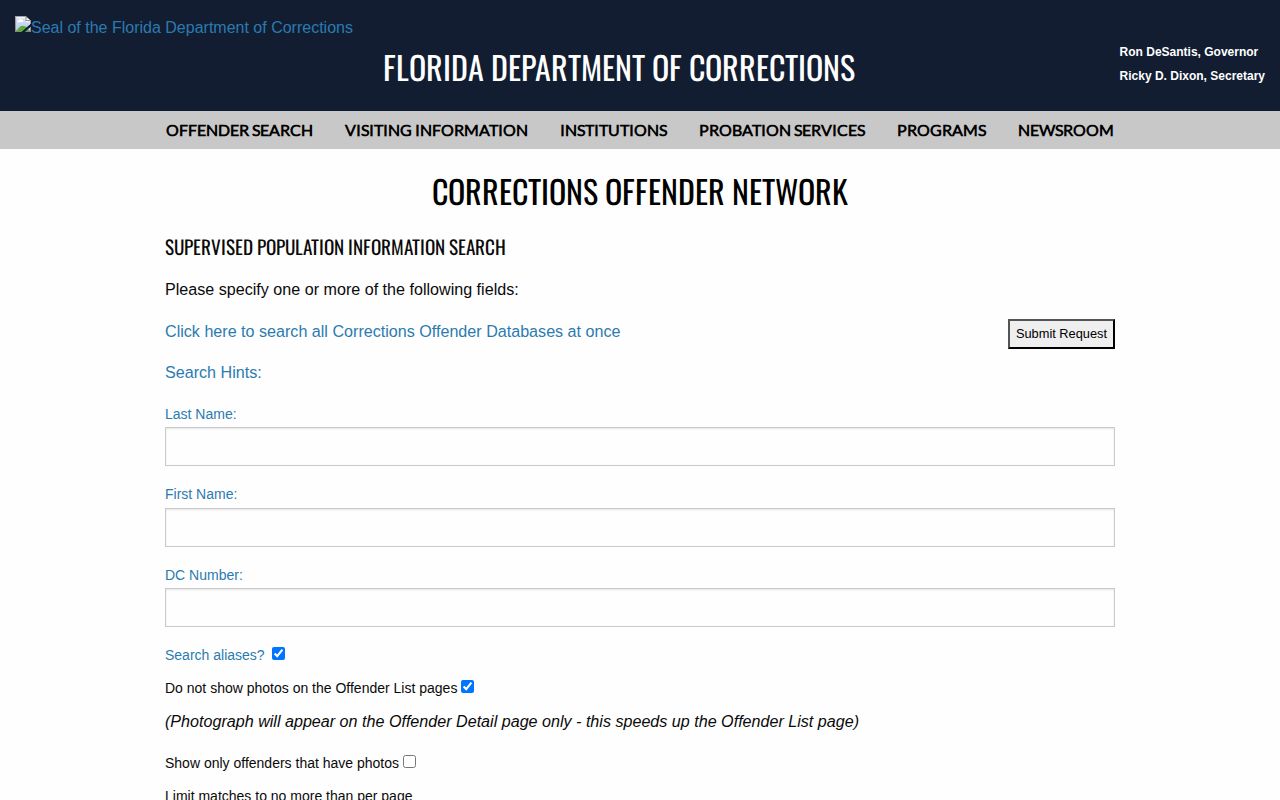
A registry result is not a substitute for this process. The FDLE Sexual Offender and Predator Search covers only people with a legal registration duty, and its classification does not establish the exact date a jail or prison released someone. A person may also have state supervision without appearing in that registry. Use the registry only for its defined population, then return to FDC or the county order for probation, parole, conditional release, or PTR status. This keeps a narrow statutory record from being mistaken for a complete list of Osceola County supervised people.
Note: FDC expressly excludes county probation, so a state no-match does not rule out an Osceola County supervision order.
Osceola Supervision Office Contacts
Osceola County is in Florida's Ninth Judicial Circuit. The assigned FDC office may vary by case or specialized unit, so the office shown on the person's paperwork and live FDC detail takes priority. The current local state office is the FDC Circuit 9 Osceola Intake, also called Kissimmee Office 094. County probation and pretrial release are separate local channels listed in the Osceola Corrections contact directory.
FDC Circuit 9 Osceola Intake1605 North John Young Parkway
Kissimmee, FL 34741
407-846-5215 Osceola Community Corrections / Probation
317 Church Street
Kissimmee, FL 34741
407-742-4700
Monday through Friday, 8 a.m. to 5 p.m. Osceola Pre-Trial Release Office
402 Simpson Road
Kissimmee, FL 34744
407-742-4550
Monday through Friday, 8 a.m. to 5 p.m.
Community Supervision, PTR, and Home Confinement also list 407-742-4574. A person under supervision should follow the reporting directions in the actual order. A directory address is not permission to change offices or miss a required report.
Osceola Supervision Violations and Absconders
Supervision conditions are the enforceable rules set by a court, FCOR, or the responsible corrections agency. They may include reporting, payment, movement, treatment, or other case-specific duties. The public record does not replace the written order. The official Osceola pretrial release page warns that failure to check in can lead to a warrant and revocation. Revocation means conditional release may be withdrawn after the required process.
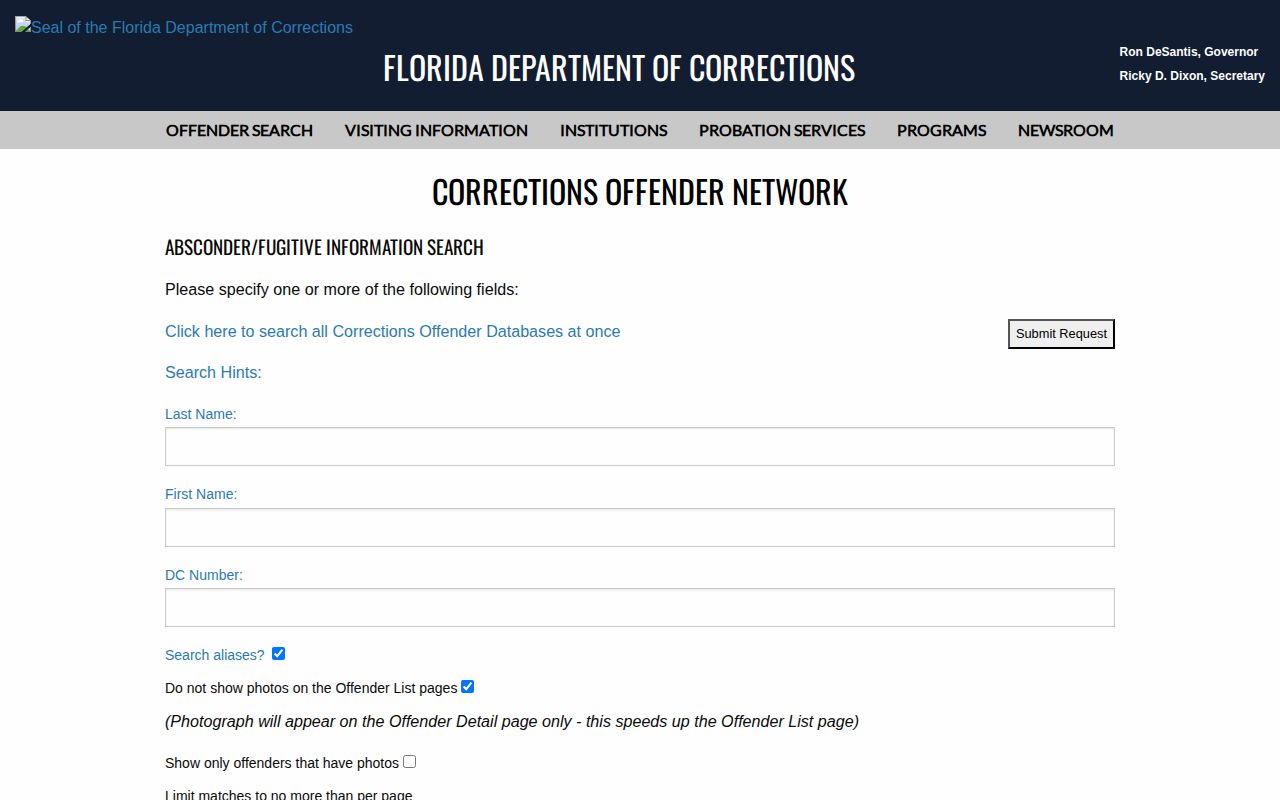
An absconder entry means an alleged failure to remain in contact or comply, often paired with a violation warrant. It does not erase the prior release event. FDC maintains a distinct Absconder/Fugitive search, which should not be read as the ordinary supervision list. For a court warrant, confirm with the issuing court or law-enforcement agency. Osceola Corrections says jail staff do not perform general warrant checks.
The official FDC Absconder/Fugitive form illustrates the separate status channel.
Osceola Parole Decision Records
Florida parole is not the usual path for modern sentences. FCOR states that ordinary crimes committed on or after October 1, 1983 generally do not qualify, subject to narrow offense-date and legal exceptions. Section 947.16 sets interview timing only for people who are actually eligible. A current FDC prison record should not be treated as evidence that a parole hearing will occur.
FCOR publishes a Commission Voting Schedule and detailed case agendas. The agenda can show a name, DC number, county, offense, case number, category, and whether the matter goes to a panel or full commission. It is a docket, not a result. Labels such as initial interview, effective interview, revocation, or conditional release establishment identify the matter being heard, not the final vote.
When the legal result is needed, request the Commission action or order through FCOR public records. Include the name, DC number, and meeting date. Then compare that order with the FDC Inmate Release or Supervised Population record. FCOR makes the decision, while FDC officers perform routine state supervision.
Note: FCOR's public agenda can locate an Osceola matter, but only the action or order establishes the Commission's decision.
Osceola Records After Release
Post-release records extend beyond a supervision status. The county's inmate services page says a former Osceola jail resident may sign into SmartJailMail with the inmate number and password to download processed photos, messages, and postal mail without charge. The former resident cannot reply or open institutional request, grievance, or medical forms. This access is a practical way to recover personal digital material after the custody account changes, but it says nothing about probation, parole, or a case result.
Florida's GS2 retention schedule also describes incarceration records that may contain receipts for money or property returned at release and transfer orders showing property that moved with a person. Those records can help distinguish a community release from a transfer. They should be requested from the agency that held the person.
For a broader release record path, the Osceola County released inmate search explains how jail, court, FDC, VINE, and receiving-agency records fit together. Keep the custody event and the supervision event separate when matching dates.
Osceola Supervision Discharge Records
Supervision ends through a formal discharge, termination, expiration, court order, or other authorized action. A prison release date does not establish that later supervision has ended. In the FDC record, read the supervision history and termination information. For county probation, use the Osceola court docket and Community Corrections record. For FCOR matters, obtain the relevant Commission action.
Use dates with care. A database update may follow the actual event, and a later violation case may create a new record. Match the DC number or county case number, the type of supervision, the office, the start and end dates, and the controlling order. If those pieces conflict, contact FDC Central Records at 850-488-9859 for a state record or the named local custodian for an Osceola order. Documentary confirmation is stronger than an assumed end date.
For copies beyond the public FDC detail, submit a focused request through FDC public records using the person's full name and DC number. State whether the requested item is a supervision termination, release history, violation record, or other named document. FCOR records should be requested separately when the issue is a Commission decision. That split reflects the actual agency roles: FDC maintains custody and supervision data, while FCOR holds its actions and orders. Osceola County records remain the right channel for county probation or pretrial material.